
It was the ’90s. While visiting Planejar's stand at our hometown's yearly agricultural fair, my stepfather acquired a revolutionary DOS application. ADM Rural.
Little did I know the impact that its blue screen would have on my childhood. It had everything a farm could ever need. I mean, everything.
There is something reassuring about a program that appears to have anticipated every bit of the agricultural world. Whatever the work might require, someone had considered it, given it a place, and made it available within the same system.
Agriculture had finally entered the computer, while bringing a considerable amount of its furniture.
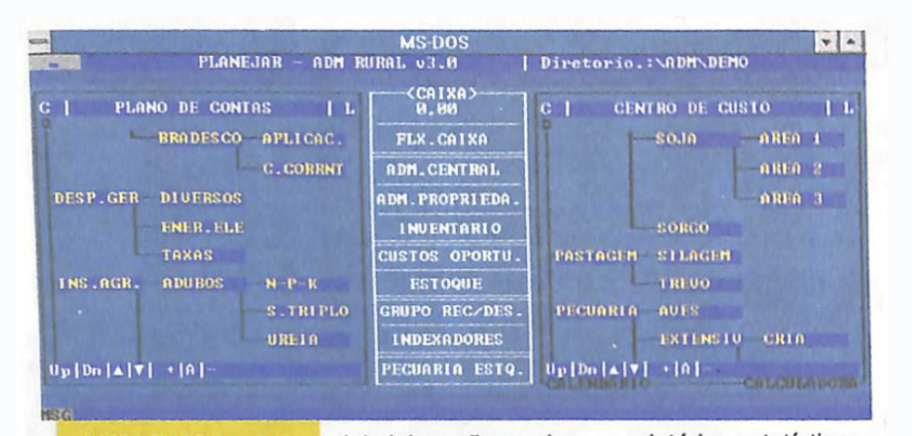
We got serious about it. I spent months digitizing those old green report sheets, filled in by hand with truckloads, weights, grain entering and leaving the silos, and seemingly every movement the farm could make. Months and months of turning green paper into records on a blue screen. I found it fascinating. Something about translating all that agricultural life into a computer took up permanent residence in my brain.
I valued that completeness, and we have used the software for years. The knowledge accumulated within it deserved respect: people had understood the work well enough to translate its requirements into a data structure others could depend on.
Over time, though, it began to weigh on us, and we found ourselves coming back to it less and less. My stepfather had a line he repeated throughout those later years: “The problem with ADM Rural is its completeness.” That stayed with me. The very thing that had fascinated me as a child had become something we struggled to keep up with.
The capabilities were still there, alongside the tables, structures and effort required to find our way through them. Having something available and being able to use it comfortably were separate achievements.
A magazine advertisement from the time put the price at R$960, in three installments of R$320. Roughly R$6,500 in 2026 money — about US$1,260.
I grew up around rice farming and have spent much of my professional life building digital products. My years of firsthand use were with ADM Rural. When I look at Agworld, I see a later, more connected generation of comprehensive agricultural software, bringing together farming, planning, records and collaboration.
Both products will continue to develop and serve people whose work calls for that depth. Farms has a different purpose, and we have no intention of reproducing everything they do.
I see an adoption gap between what agricultural software can make possible and how many people can meaningfully use it in everyday life.
For me, closing that gap begins with being of benefit. We are building Farms to bring the greatest practical benefit to the greatest number of people in agriculture. Today, the agentic era gives us new tools to pursue that purpose.
A capability may be technically impressive, commercially attractive, or personally irresistible to an engineer. We still have to understand whom it helps, how it helps, and what it asks of the person using it.
I use range to describe how far that usefulness can travel: across different responsibilities, resources, levels of technical familiarity, and the relationships through which agricultural work happens. A farmer, an agricultural pilot, an independent drone operator, an agronomist and a field crew have different needs. What interests me is where their work intersects and a tool becomes useful to more than one of them.
Those intersections are already part of Farms’ story. Oswaldo built the original Farms application for his own agricultural aviation operations, addressing problems whose consequences he knew firsthand. As it developed, farmers and drone operators were already using it and asking for capabilities suited to their work. My work on this next generation follows that expansion beyond its original focus.
Spending years close to agricultural work, while building technology for it, changes what you notice. You begin to understand which tools need to be together, which connections would save someone a considerable amount of trouble, and when another feature is mostly another thing to look after. That experience gives the search its direction.
Listening has always been part of Farms’ DNA. The people using Farms help shape where it goes. That means understanding the work behind a request, where someone is struggling, and what would actually help them.
To think about where those conversations could lead, I picture the agricultural technology world as an enormous neural network of capabilities and relationships. Land, agronomy, equipment, finance, people, inputs, records and logistics extend throughout it. Some capabilities are deeply specialized. Others matter to a remarkable variety of work.
Follow a spraying operation. The agronomist may also fly the drone. The farmer may operate equipment or hire a provider. The same field boundary informs the agronomic instructions, the operator’s plan and the provider’s schedule. Equipment, conditions and inputs shape those decisions; each consumes time and resources. Observations and execution records then become part of what the farmer and the next crew need to know. A photograph needs its place and moment to make sense.
The essential network we are searching for draws capabilities from within and across those domains, preserving their connections even when they cross the boundaries of software modules.
Turning those relationships into software brings me back to my stepfather’s observation. The data model establishes what must exist, how things relate and what information is required before work can proceed. The interface inherits those obligations as forms, choices and setup steps.
Imagine that recording a simple job requires first defining an organization, a farm hierarchy, a season and a budget. Each dependency may be reasonable individually. Together, they ask the person to construct an administrative world before recording the work they came to do.
The interface becomes the place where architectural decisions send their invoices. The person pays in attention, configuration and time.
There is a point of no return for interface work alone: recovering the experience requires revisiting the data model, because rearranging screens cannot remove the demands built into it.
A sophisticated internal structure can still support a simple experience. The difficulty begins when its complexity becomes an unavoidable responsibility of the user. Data structure, interface and intended experience have to be designed together before the first screen is drawn.
A single-purpose app can do its job very well and still have limited range. Its usefulness may stop at that job, or at the group of people who need it. When the work requires another capability, or a connection the app does not provide, someone has to go elsewhere to finish it, carrying the context with them.
Comprehensive platforms bring more of that work together. That depth matters to people whose operations require it. But understanding, configuring and maintaining the system can demand more than its benefit justifies. When that happens, more becomes available while fewer people can comfortably use it.
Both approaches have a place. For Farms, the search is for tools that give each participant enough practical value to choose the product independently, then connect them through the work they share. I call that benefit convergence. Each addition has to earn the attention, setup and money it asks of the person using it.
Single-purpose apps and comprehensive platforms can both be of benefit. The mix has to serve the work.
Adoption: At the peak. The tools work together with manageable effort. The benefit can reach more people.
Two products with the same number of tools can offer very different benefits. A demanding business may need a depth that would overwhelm someone doing a different job. Both need a product worth coming back to.
I believe the agentic era changes what we compete on. As capabilities become cheaper to build and easier to replicate, choosing what belongs together becomes the advantage. The search is for the combination that delivers the greatest practical benefit.
Atlas gives me a way to think about that search. Our planning and simulation engine helps pilots and operators explore supported aircraft and drone operations, comparing routes, estimated time and resource requirements before committing to a plan. Finding a useful path means understanding how geometry, equipment, turns, replenishment and weather work together within that operation. Its estimates carry assumptions and limits that must remain understandable.
In our product search, experience helps us understand the field: that network of agricultural capabilities. The equipment is the set of tools available in this era. We explore combinations within that network, looking for benefit convergence with the widest possible range. Our constraints include what we know how to build, what people can afford, what they can comfortably use, and what the technology can actually be trusted to do.
The market has yet to provide us with a convenient Run Simulation button, so our candidates have to meet people doing real work. Their experience helps us understand those constraints, recognize what is useful or creates unnecessary effort, and revise the combination with them.
The agentic era opens a window to redefine agricultural software around benefit convergence. We bring operational knowledge, people already using Farms and the engineering experience to act on it.
I see that change in my own engineering work, where AI participates in implementation, investigation, refactoring and testing. We remain responsible for the intent, the constraints and the consequences.
V5 grew from work already happening in Farms and requests that kept returning. Companies were using it with multiple employees before we had properly accommodated their teams. Farms Services gives that work a home. We rebuilt the technology around that accumulated understanding, using the agentic era to expand what those workflows can do.
An agent needs dependable context and tools: which field someone means, which records are relevant, and what those records establish. A plan, an observation and a completed operation carry different meanings. A fluent answer still needs to get those distinctions right.
We designed the area to hold both original records and the context Sofia builds from them. As observations, photographs and job records accumulate, Sofia keeps that context up to date, preserving its history and links to the underlying sources.
We have also built tools that let other AI assistants read authorized Farms information through MCP, a protocol for connecting them to applications. This is where I see benefit convergence taking shape: these capabilities help people use accumulated knowledge without repeatedly reconstructing its history.
Range also depends on who can participate. Every user should have room to use Farms and help shape it, whether they work alone or manage a large operation. Providers serve several farms, farmers work with different providers, and pilots, operators, agronomists and crews move between places and responsibilities. Farms needs to fit those relationships while being useful to each person independently.
A provider should be able to organize work before any customer joins. Farmers, pilots and drone operators should have tools for their own areas, operations and records. People can bring their providers, and providers can bring the people they work with. Someone may arrive through another person’s job and stay because Farms is useful for their own. Their next operation can introduce it to someone else.
The way we charge has to support that participation. I do not want price to become a blocker. Listening to what people need, what they can afford, and how they can comfortably get their work done has to guide both the features and the price.
The model we are building combines a useful free core with paid workspaces for additional management, team capacity and storage. Premium simulation and AI give people additional reasons to choose a workspace of their own, grounded in the work they need to do. Workspaces can cover invited collaborators, so shared work does not require a separate purchase from every person involved. That model has to sustain the company while leaving room for people to participate.
When I think back to that blue screen in 1995, I still admire how much of the agricultural world someone had managed to put inside a program. Today, we are building the connected essentials to make that knowledge useful to more people. We have the tools, the experience and the people to find that network. I believe we will.
As we find the right connections, we gain range. And range matters because it carries the benefit further.
Price reference: the May 1996 A Granja advertisement lists ADM Rural 3.0 at 3 × R$320. The rounded comparison uses the average 1995 IPCA price level as an approximate reference, adjusted to September 2026. The dollar equivalent uses Banco Central’s September 2026 average exchange rate, R$5.1447 per US$1.